
Common Pickleball Injuries and How to Treat Them
More and more people are playing pickleball. According to the SFIA's 2026 Topline Participation Report, 24.3 million Americans played pickleball in 2025: that’s more than a 171% increase over the past three years. The sport is known for being accessible and low-impact, which is why players of all ages sometimes log far more court hours than their bodies may be ready for, particularly those returning to athletic activity after years away. As a result, emergency department visits for pickleball-related injuries rose from roughly 1,313 in 2014 to 24,461 in 2023, according to a NEISS database study.
The orthopedic consequences are measurable. A 2025 nationwide survey of pickleball players found that 68.5% reported at least one injury in the prior 12 months, with 40.8% experiencing injuries that forced them off the court for at least a day. Understanding which pickleball injuries are most common, why they happen, and how to treat them can mean the difference between taking a week off from playing and dealing with months of rehabilitation.
What Makes Pickleball Physically Demanding
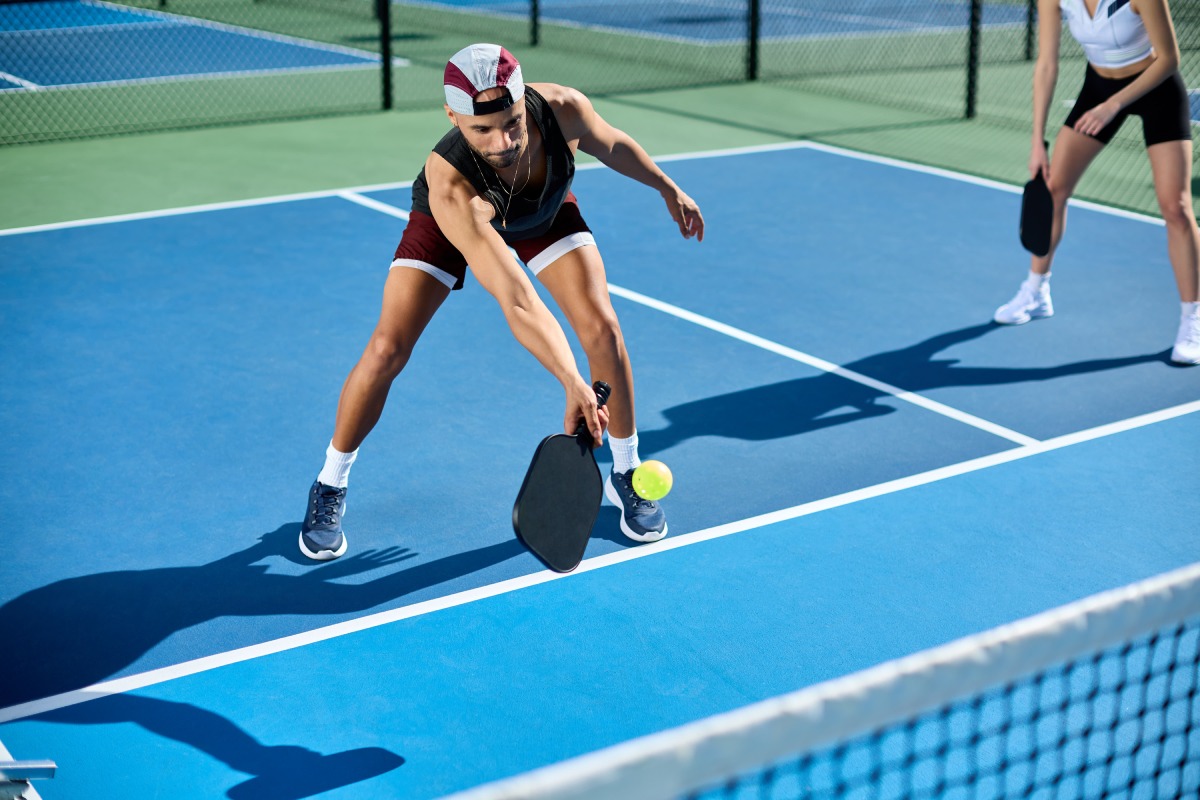
Pickleball is played on a smaller court than tennis, but the compact space drives a specific movement pattern: short-burst lateral cuts, frequent direction changes, and repetitive overhead and dinking strokes that load the forearm, elbow, and wrist hundreds of times per session. The combination of these demands with the sport's social, low-barrier format means players often stay on the court far longer than they would in a higher-intensity sport.
Most of the game is played below the waist at the kitchen line, which reduces the incidence of shoulder injuries but concentrates stress at the wrist and elbow. Repetitive motion gripping and wrist extension against a solid ball and rigid pickleball paddle produce strain patterns that accumulate slowly and are easy to ignore at first.
The player demographics matters too. People of all ages play pickleball: 21% of players are under 25 and 13% of players are 65 and over. The same playing volume that was manageable at 40 carries a meaningfully higher overuse injury risk at 60. Knowing which injuries are most common for your body is the starting point for avoiding them.
Pickleball Elbow: The Most Common Upper Extremity Injury
What Is Pickleball Elbow?
“Pickleball elbow” is the common name for lateral epicondylitis—the same condition known as tennis elbow. It involves inflammation and small tears at the common extensor tendon where it attaches to the bony bump on the outside of the elbow, called the lateral epicondyle, caused by repetitive wrist extension and gripping. This is a classic overuse injury: no single swing causes it, but hundreds of swings per session, repeated across multiple days per week, eventually outpace the tendon's ability to repair itself.
The extensor carpi radialis brevis tendon is most commonly involved. Every backhand stroke, drive, and overhead snap loads this tendon under tension. When cumulative repetitive stress causes the tissue to degenerate, the result is the characteristic aching pain on the outer elbow that pickleball players know well.
Distinguishing pickleball elbow from other elbow pain matters. Lateral epicondylitis affects the outside of the elbow and worsens with wrist extension and gripping. Pain on the inner elbow—medial epicondylitis, also called golfer's elbow—has a different mechanism and different treatment approach. Location is diagnostic. Don’t assume that both sides of the elbow are the same problem.
Warning Signs
The most common early symptom is a dull ache on the outer elbow that appears after long sessions and resolves with rest. As the condition progresses, the pain becomes persistent—present during play, lifting, turning a doorknob, and, in some cases, at rest overnight.
Weakened grip strength and discomfort during backhand strokes are the two most reliable indicators. Players who notice they are gripping the pickleball paddle harder to compensate for lost strength are often accelerating the injury without realizing it. Squeezing harder increases tendon load with every swing.
Pain that has been present for more than six weeks, that has not responded to rest and over-the-counter pain relievers like ibuprofen, or that is accompanied by significant grip weakness warrants evaluation by an orthopedic surgeon or sports medicine provider. At that point, self-management is unlikely to resolve the underlying tendon pathology.
Other Upper Extremity Injuries in Pickleball Players
Rotator Cuff Tendonitis
Overhead smashes and high volleys place repeated stress on the rotator cuff tendons, particularly in players who rely on arm strength rather than body rotation to generate power. The result is inflammation of the tendons that control shoulder stability and arm rotation and, over time, potential partial tearing.
Rotator cuff tendonitis in pickleball players typically presents as a dull ache in the shoulder that worsens with overhead activity and eases at rest. Night pain and weakness with lifting the arm away from the body are red flags that warrant imaging. These symptoms are not normal post-play soreness. Physical therapy focused on scapular stabilization and rotator cuff strengthening is the first-line treatment for most cases.
Wrist Strains and Sprains
Wrist injuries in pickleball occur both acutely—from a fall on an outstretched hand or awkward contact with the ball—and as an overuse injury from repetitive wrist extension and forearm supination during groundstrokes and dinking.
Wrist strain involves the tendons or muscles. A wrist sprain occurs when ligaments are stretched or torn. Both produce localized pain and swelling, but sprains often present with instability or a sense of the joint giving way that strains do not.
Falls are a meaningful source of wrist fractures in pickleball, particularly among players over the age of 60. Any mechanism of injury involving a fall on an outstretched hand warrants imaging to rule out a fracture before the injury is treated as a soft tissue problem. Mild strains and sprains respond to activity modification, ice, and a short course of anti-inflammatory medications.
Lower Body Injuries for Pickleball Players
Achilles Tendonitis and Rupture
The Achilles tendon absorbs the repetitive push-off demands of lateral court movement and the explosive split-step that competitive pickleball requires. For players who haven’t conditioned the calf-Achilles complex for this pattern of activity, Achilles tendonitis develops gradually, progressing from post-play stiffness near the heel to pain during play and, in severe cases, partial or complete rupture.
Here are the warning signs of a tendon approaching rupture:
- Chronic dull pain at the back of the heel that doesn't fully resolve between sessions
- Morning stiffness that requires several minutes of walking to ease
- Visible swelling along the tendon
- A subtle change in gait as the body compensates to protect the tendon
These symptoms are easily recognizable if you know what to look for. They are signals that the tendon is under more stress than it can currently tolerate.
A complete Achilles tendon rupture is a surgical emergency. The hallmark presentation is a sudden, sharp pain in the back of the lower leg during play, often described as feeling like being struck or kicked from behind, followed by an audible pop and immediate inability to push off. Players with this presentation should not attempt to continue play or walk on the affected leg. Evaluation and imaging are needed immediately.
Achilles tendonitis caught early responds well to eccentric calf strengthening, activity modification, and appropriate footwear. Players who push through progressive heel pain without intervention are the ones who end up facing more serious outcomes.
Plantar Fasciitis
Plantar fasciitis is inflammation of the thick band of tissue that runs along the bottom of the foot, connecting the heel bone to the toes. In pickleball, repetitive lateral cutting and quick directional changes on hard court surfaces produce the sustained loading that drives plantar fascia irritation.
The characteristic presentation is sharp heel pain with the first steps of the morning that eases after a few minutes of walking, then returns after extended court time. Players who dismiss this as normal soreness often develop a chronic condition that requires months of treatment, which is far longer than it would have taken to address it at first presentation.
First-line management includes stretching the plantar fascia and calf consistently, supportive footwear with adequate arch support, and reducing court time during the acute phase. Corticosteroid injections and physical therapy are appropriate for cases that do not respond within four to six weeks.
MCL Strains
The medial collateral ligament (MCL) stabilizes the inner knee joint. In pickleball, MCL strains most commonly occur from a sudden lateral pivot or an awkward landing after a reach, placing a valgus (inward) stress on the knee that stretches or tears the ligament.
Grade 1 and 2 MCL strains involve stretching and partial tearing without joint instability. They are typically managed conservatively with rest, a hinged knee brace during activity modification, and progressive rehabilitation. Grade 3 tears involve complete ligament disruption and may require surgical consultation.
Players returning too soon from a knee ligament injury risk re-injury and, over time, accelerated cartilage wear. Clearance from a sports medicine provider before returning to court is appropriate for any knee injury that involves significant pain, swelling, or instability.
Preventing Pickleball Injuries Before They Start
Dynamic warm-up before play is more effective than static stretching for injury prevention. Leg swings, hip circles, arm circles, and lateral shuffles raise tissue temperature and increase joint mobility before the game begins. Static stretching held for 30 or more seconds is better suited to the cooldown phase after play, not the warm-up.
Eccentric calf strengthening and forearm extensor exercises are evidence-based strategies for preventing injuries. Do them consistently between sessions. Doing them before pain appears is far less costly than doing them after.
Volume management is also important. Increasing weekly court time by more than 10% per week is a known driver of overuse injuries across sports. Players returning after a break or ramping up their game should increase volume gradually and treat early soreness as a signal to take a break, not as discomfort to push through.
When Pain Means It's Time to See a Specialist
Not every ache after pickleball is an injury. Muscle soreness that resolves within 48 hours of play is normal adaptation. You should seek professional evaluation if you experience pain that persists beyond 48–72 hours, worsens with continued play, or is accompanied by swelling, instability, weakness, or any acute structural event, such as a pop, a snap, or a sudden inability to bear weight.
Early intervention changes outcomes. Players who seek a sports medicine evaluation for Achilles tendonitis before it progresses to rupture, or for pickleball elbow before the tendon degenerates into a chronic state, consistently have shorter recovery timelines and better long-term function than those who manage with over-the-counter pain relievers and court time reduction indefinitely.
Alexander Orthopaedics provides outpatient orthopedic and sports medicine care across multiple locations in the Tampa Bay area, with orthopedic surgeons and physical therapists who treat sports injuries and pickleball injuries every day. If you’re experiencing sudden pain or persistent soreness from athletic activity, come see us for an evaluation.